
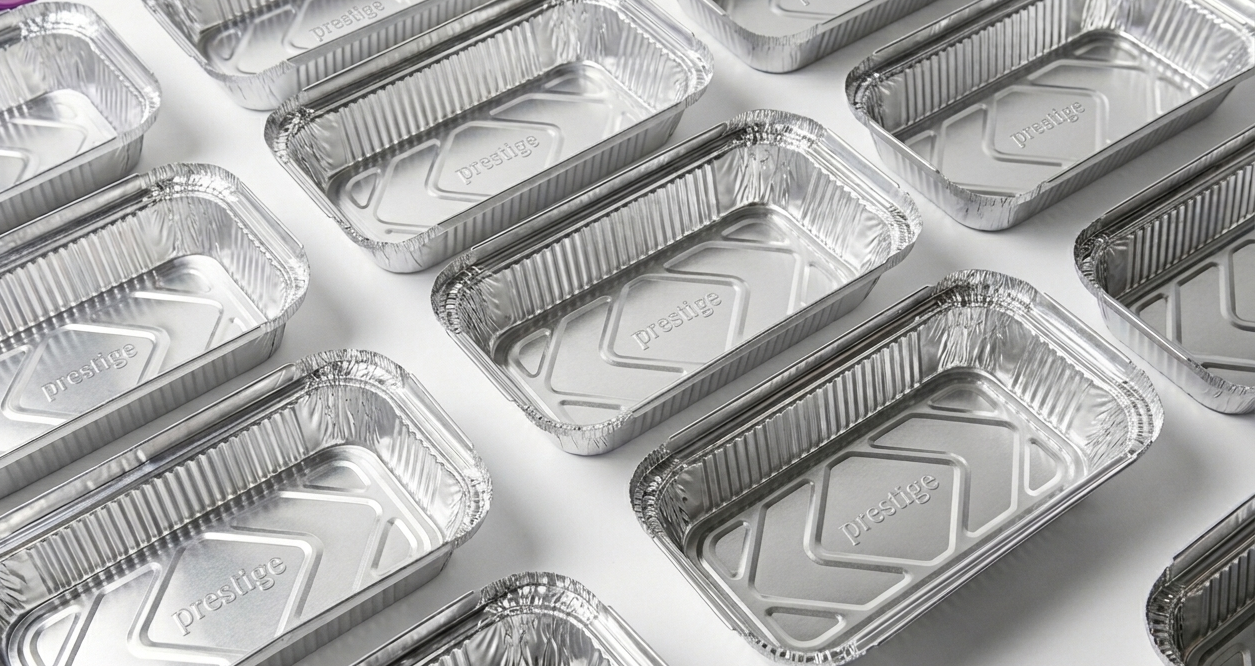
Disposable aluminium packaging connects everyday food service with a worldwide supply chain. From takeaway meals and bakery trays to large catering orders, the right container helps businesses prepare, pack and present food consistently. For buyers in the UAE and overseas, understanding the world market is also useful when planning stock, comparing quotations and choosing suppliers.
What is disposable aluminium packaging?
The category includes aluminium foil food containers, trays, platters and household foil used for food preparation and service. This article focuses on food containers and related foil products. Beverage cans and pharmaceutical foil belong to wider aluminium packaging markets and should not be confused with this segment.
The world market: measured growth, with regional differences
In its August 2026 update, Fortune Business Insights estimates the global aluminium foil containers market at US$3.87 billion in 2025, with a projected US$4.05 billion in 2026 and US$5.86 billion by 2034. Its forecast implies annual compound growth of 4.71% from 2026 to 2034. These are one research firm’s estimates and projections, rather than audited worldwide sales or guaranteed outcomes.
The same report identifies Asia Pacific as the leading region, followed by North America. It links demand to food delivery, packaged meals and catering, and describes hospitality and food packaging growth in the Middle East and Africa. Different regions therefore offer different opportunities; a single worldwide forecast cannot describe every local market.
A current signal from Europe
The European Aluminium Foil Association’s August 2026 update reports approximately 238,000 tonnes of member deliveries in the second quarter, up 0.6% year on year. First-half deliveries remained 3.0% below the previous year. These figures cover aluminium foil across several applications, not just disposable food containers. They show stabilisation after a weaker start, rather than a uniform boom.
Why food businesses use aluminium containers
The European Aluminium Foil Association describes foil containers as lightweight, stackable packs that can support stages from filling and chilling to distribution and reheating, depending on the product specification. Practical advantages include:
- A wide choice of formats: shallow trays, deep containers and compartment designs for different portions and menus.
- Efficient handling: nesting and stacking can simplify storage and packing operations.
- Flexible presentation: different rims, lids and finishes suit different service requirements.
- Process compatibility: suitable specifications can work across preparation, storage and serving stages.
Always check the specific container and lid instructions for the food, storage conditions and heating equipment involved. A material’s general properties do not establish the suitability of every finished pack.
Recycling: the opportunity depends on collection
According to the International Aluminium Institute, recycling aluminium saves approximately 95% of the energy required for primary aluminium production. This is a comparison of metal production processes, not a claim that every disposable container has a 95% smaller environmental footprint.
For packaging buyers, the practical question is whether used trays can actually enter a local collection and recycling system. Ask the waste contractor which foil containers are accepted, how food residue should be removed and whether lids need separating. Recyclability alone does not guarantee recycling; material use, collection, sorting and processing all influence the result.
What UAE and international buyers should check
Our practical view is that procurement should connect market awareness with a clear packaging specification. A low unit price is only useful when the pack performs reliably in your operation.
- Capacity and dimensions: confirm usable volume, depth and portion fit with actual meals.
- Strength: test filled packs for handling, stacking and delivery conditions.
- Lid compatibility: confirm the closure, fit and intended use of both components.
- Product documentation: request specifications and relevant food-contact documentation for the intended destination and application.
- Order details: compare pieces per carton, lid inclusion, minimum quantities and lead times.
- Delivered cost: include freight, storage and expected damage when comparing offers.
For distributors, a focused range of regularly ordered sizes can make replenishment easier. For restaurants and caterers, sample trials provide a practical way to choose the right pack before committing to volume orders.
Explore aluminium packaging from Prestige Packs
Prestige Packs offers a starting point for businesses sourcing aluminium food packaging in the UAE. Explore our aluminium food containers, aluminium platters and aluminium foil range.
Planning a bulk order? Contact Prestige Packs with your required sizes, quantities, lid preferences and delivery destination to discuss suitable options and current availability.
Market information checked on 9 September 2026. Forecasts may change as research providers update their estimates.